Intercompany Margin Distortion Control
Prevents transfer-pricing cost signals from distorting commercial decisions when intercompany products are sold cross-border and foreign sales teams are measured on contribution margin. It decomposes the intercompany cost stack, discloses the enterprise-view margin alongside the local view, and routes high-impact decisions through a named owner.
Changelog
| Version | Date | Description |
|---|---|---|
| Initial Release | Apr 15, 2026 |
Scope / Trigger
This framework applies when a multi-entity organization moves goods between entities under arm’s-length transfer pricing (typically cost-plus or TNMM), and the receiving entity’s ERP landed cost is reused as the cost basis for commercial contribution margin, deal-approval thresholds, sales incentives, or sourcing decisions. It governs the boundary where compliance-driven cost signals enter commercial decision-making.
Typical trigger conditions:
- Intercompany product transfers are material to commercial volume in the receiving entity.
- Local CM (or equivalent margin KPI) drives discount approvals, deal prioritization, sales incentives, or sourcing comparisons.
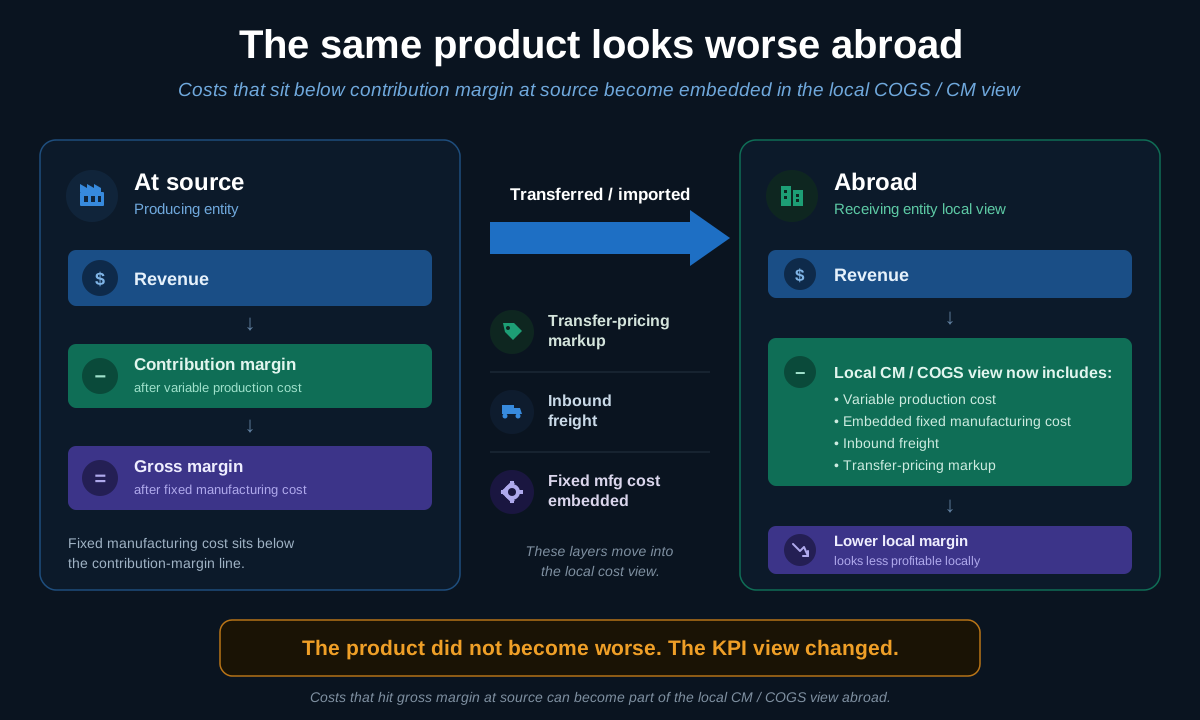
- The transfer pricing method embeds fixed overhead absorption, intercompany markup, or inbound freight into the intercompany price.
- A single landed cost arrives in inventory at the receiving entity, with no visibility into its composition.
A useful diagnostic is to compare local CM% and enterprise-view CM%. The framework should apply when the gap is material enough to affect pricing, sourcing, discount approval, or product-prioritization decisions. Each organization should set materiality using its existing management-reporting and control practices.
Failure Mode
A compliance-driven cost signal silently becomes a commercial decision input. The receiving entity’s ERP landed cost — built for transfer-pricing compliance — is reused as the cost basis for contribution margin, and no one notices that it carries components which do not belong in a commercial CM: fixed overhead absorption, intercompany markup, and inbound freight. The receiving entity sees a single landed cost with no visibility into its composition.
The result is systematic understatement of intercompany product margin in the local view. Sales teams respond rationally to the bad signal: tighter discount thresholds, deal deprioritization, and sourcing switches to local suppliers that look cheaper locally but destroy enterprise margin once the markup eliminates on consolidation. The distortion compounds — as volume shifts away, the producing entity loses absorption, unit cost rises, and the next cost roll-up makes the internal product look even worse.
The same unit, the same customer, the same price — measured 17 points apart depending on which view is taken. The gap is not an accounting error. It is the predictable result of using a compliance-driven cost inside a commercial KPI.
Control Rule + Owner
For intercompany products where the gap between local CM and enterprise-view CM is material, commercial decisions covered by the decision gates — sourcing switches, product delisting, major discount rejections, product-line deprioritization — require enterprise-view review before action.
Owner: Business unit controller or enterprise FP&A. Not tax. Not sales. Tax owns transfer-pricing compliance. Sales owns execution. The governance gap sits between them — the framework places ownership there.
Allowed exceptions:
- Centralized global pricing already enforces enterprise economics in commercial decisions — framework not required for those products.
- Products where fixed overhead and markup content are immaterial relative to unit economics — documented exemption.
- Time-critical commercial decisions where named owner provides expedited written review (no full diagnostic delay).
Documentation threshold: Any sourcing switch, product delisting, or discount rejection on a flagged intercompany SKU must include a written enterprise-view bridge in the decision record. One page is sufficient.
Cost-signal scope constraint: This framework governs short- to medium-term commercial decisions — deal pricing, discount approval, sales incentive measurement, individual sourcing trade-offs. It does not apply to long-term strategic decisions such as plant viability, capacity expansion, or strategic pricing, where full-cost analysis remains appropriate. Local CM remains valid for legal-entity reporting, tax filings, customs documentation, and statutory profitability.
A useful diagnostic is to compare local CM% and enterprise-view CM%. The framework should apply when the gap is material enough to affect pricing, sourcing, discount approval, or product-prioritization decisions. Each organization should set materiality using its existing management-reporting and control practices.
Minimum Viable Implementation
-
- Identify intercompany SKUs where commercial volume is material at the receiving entity.
- Decompose the intercompany cost stack across three views: producing entity, receiving entity, consolidated enterprise. Use existing transfer-pricing documentation — do not build a parallel costing system.
- Calculate the gap between local CM% and enterprise-view CM% for each flagged SKU.
- Set a materiality level using existing management-reporting and control practices. SKUs above it enter the framework.
- Add an enterprise-view bridge column to commercial reporting (BI dashboards, deal-desk approval forms, product-line review packs) for flagged SKUs only. Do not modify the ERP.
- Define the decision gates: sourcing switches, product delisting, major discount rejections, product-line deprioritization on flagged SKUs.
- Name the owner who reviews the enterprise-view bridge before action on gated decisions. Document the role formally.
- Review the gap quarterly. If a SKU’s gap closes, remove it from the flag list. If new SKUs cross the threshold, add them.
The framework does not require ERP changes. In most cases it is safer to preserve the legal ERP cost and add the enterprise-view bridge in commercial reporting, deal-desk forms, or product-review packs.
Impact Logic / Cost of Inaction
Formula: Annual margin exposure = (Enterprise CM% − Local CM%) × annual revenue of flagged intercompany SKUs in the receiving entity. Actual margin loss depends on the commercial response to the distorted signal — rejected discounts, lost bids, or sourcing switches.
Worked example: $20M annual revenue of intercompany products flowing through a European subsidiary. 17-percentage-point gap between local CM and enterprise CM.
Annual margin exposure: $20,000,000 × 17% = $3,400,000 of enterprise margin systematically misrepresented in commercial decisions.
Behavioral impact: even a 10% commercial response — deals not closed, discounts not approved, sourcing switched — represents $340,000/year of avoidable enterprise margin loss.
Sourcing switch impact: a single $5M-revenue SKU switched from intercompany supply ($113 enterprise variable cost) to a local supplier at $135 destroys approximately $22 per unit × unit volume of enterprise margin per year.
Cost of this control: Existing transfer-pricing documentation. One additional column in commercial reporting. One named owner reviewing flagged decisions. No ERP changes. No accounting changes. No tax structure changes.
When It Stops Working
- Intercompany product flows are immaterial. The framework targets commercial decisions on intercompany SKUs. If the receiving entity processes mostly third-party purchases, the structural distortion does not exist.
- Centralized global pricing already enforces enterprise economics in commercial decisions. The framework adds no value where commercial decisions already use enterprise-view cost.
- Fixed overhead and markup content are small relative to unit economics. The cost signal gap is too narrow to change commercial behavior. Diagnostic still useful, but decision gates do not trigger.
- Services or solutions businesses where value creation does not run through inventory cost of goods sold. The framework targets product-COGS distortions specifically.
- No cross-functional governance ownership exists. The framework requires a named owner outside tax and outside sales. If no function will accept that role, the gates cannot operate.
- Long-term strategic decisions — plant viability, capacity expansion, strategic pricing. Full-cost analysis remains appropriate for those decisions. The framework targets short- to medium-term commercial decisions only.
Field Notes
No field notes yet for this framework.
Applied this in practice, or have experience with it?
Document what you would add.
Subscribe to updates on this framework
Get notified when this framework is updated or when new Field Notes are added.
Framework: Intercompany Margin Distortion Control
Framework ID: FF-PM-001