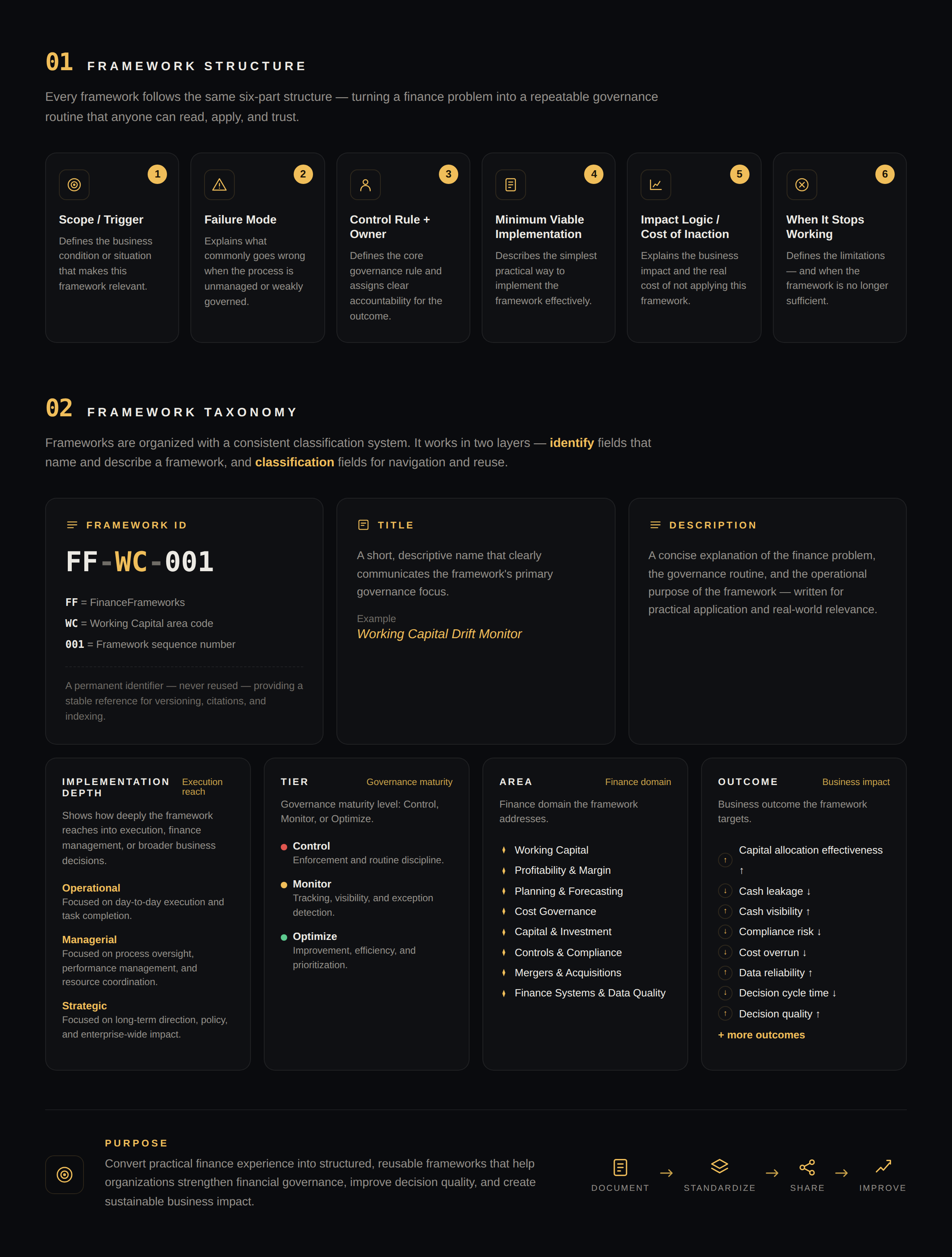
How Frameworks Are Classified
The six sections tell you what a framework says. Classification helps you
find the right one. As the library grows, labels are how you filter quickly.
Every framework carries one ID and four labels.
Framework ID — its permanent name
A fixed code like FF-WC-001, read in three parts: FF (FinanceFrameworks), the Area code
(WC = Working Capital), and the sequence number within that area. IDs are permanent and
never reused, so any link, citation, or reference always points to the same framework.
Title and Description
The Title names the framework’s focus. The Description is a few sentences on the problem it
addresses, the routine it sets up, and its purpose — enough to judge a framework before
reading it in full.
The four labels each answer a different question about that framework:
Implementation Depth — “How deep into the business does this reach?”
Shows how far the framework reaches: into day-to-day execution, finance management, or
broader business decisions.
Operational: runs at the execution level.
Managerial: sits with finance management and oversight.
Strategic: informs broader business and capital decisions.
Tier — “What governance job is it doing?”
The governance maturity level.
Control: prevents a problem directly (approvals, checks, enforcement).
Monitor: gives visibility and catches issues early (tracking, reviews, exception detection).
Optimize: improves something already working (efficiency, allocation, prioritization).
Area — “Which part of finance?”
The domain the framework belongs to, and the source of its ID letters. Eight areas:
Working Capital, Profitability & Margin, Planning & Forecasting, Cost Governance,
Capital & Investment, Controls & Compliance, Mergers & Acquisitions, and
Finance Systems & Data Quality.
Outcome — “What business result does it target, and which way?”
An arrow shows whether the goal is to raise (↑) or reduce (↓) something — for example
Cash visibility↑, Cash leakage↓, Capital allocation effectiveness↑, Compliance risk↓,
Cost overrun↓, Data reliability↑, Decision cycle time↓. A framework can target more than one.
This lets you start from a goal and find every framework built to deliver it.
Quality Charter
The Quality Charter defines the standard every framework is held to before it is released, and how frameworks are maintained over time. It exists to keep FinanceFrameworks a curated, vetted repository — not an ungoverned stream of opinions.
What We Look For
A framework is accepted when it meets the repository’s quality and provenance standards. Every submission is assessed against clear criteria:
Independent usability. A finance professional unfamiliar with the author must be able to understand the framework’s logic, assess whether it fits their situation, and begin adapting it — without needing the author’s explanation. A framework that only makes sense when its author is present to explain it is not yet a framework.
A real, recurring problem. The framework addresses a genuine finance-governance problem that recurs across organizations — not a one-off situation or a hypothetical.
Sound logic. The control logic must coherently address the failure mode it names. The reasoning has to hold.
Structural completeness. The framework follows the six-part anatomy — scope and trigger, failure mode, control rule and owner, minimum viable implementation, impact logic, and boundaries — with each part answered.
Proportionate implementation. The framework must define a minimum viable implementation appropriate to its scope — a workable starting point that does not assume more infrastructure, tooling, or staffing than the problem itself requires.
Transferable, not company-specific. The framework expresses decision logic and governance principles rather than software-specific steps or procedures tied to one employer, system, or industry.
Sound provenance. The framework must rest on an identifiable practitioner basis, carry honest attribution, support its factual claims, and disclose the material assumptions on which it depends.
What Falls Outside the Repository
To stay a curated reference, some submissions are not accepted as frameworks: commentary, opinion, or general finance discussion; unstructured tips or checklists that cannot be applied independently; content used as a marketing funnel or a channel for individualized consulting; and content tied so tightly to one company, system, or situation that it cannot transfer.
Content that substantially duplicates a framework already maintained by the repository is not accepted as a separate entry. Useful additions may instead be considered as a Field Note, variation, or proposed revision. FinanceFrameworks generally maintains one primary framework for each clearly defined problem rather than multiple competing entries that apply substantially the same logic.
How Review Works
Submissions are assessed through the repository’s framework review process against the standards above before release. A review may result in acceptance, acceptance subject to revision, return for further development, treatment as a Field Note, integration into an existing framework, or rejection.
The repository is early-stage, and review is currently overseen by the founder. As the repository grows, review may expand to qualified practitioner reviewers under documented criteria — preserving quality while allowing the repository to scale.
This is deliberate. A framework carries weight only if the standard behind it is real and consistently applied.
Field Notes
A Field Note is a short, structured practitioner observation connected to an existing framework — an implementation lesson, a useful variation, a limitation found in practice, or an anonymized real-world example. It is the lighter contribution path: a way to add value without authoring a complete framework, and it feeds back into how frameworks improve over time.
Acceptable inputs: an implementation lesson, an edge case the framework did not cover, a limitation encountered in a specific context, a workable variation, or an anonymized example of the framework in use.
Excluded: commentary or opinion; proposals for a competing framework; and anything containing confidential, employer-identifying, or proprietary information.
Every Field Note is reviewed before it appears. Accepted notes are attached to the framework they concern and attributed to their contributor unless public anonymity has been approved. Contradictory, unsupported, or low-quality notes are not released — curation keeps each framework’s record reliable rather than an open comment thread.
Anonymous Field Notes. A Field Note may be released without the contributor’s name. Some practitioners prefer to share a professional observation without attaching their name to it publicly, and that is allowed. Anonymity applies to the public byline only: the contributor’s identity and relevant practitioner basis are still known to and verified by the repository, approved case by case, and the note is held to the same review standard as a named one — including the rule that no note may contain confidential, employer-identifying, or proprietary information. The name is withheld from the audience, never from the review. Anonymity removes the byline, not the scrutiny.
This is why anonymity is available for Field Notes but not for frameworks: a framework is a permanent, attributed artifact that must rest on identifiable provenance, while a Field Note is a supporting observation the repository verifies before release.
How Versioning Works
Each framework carries a version number and a visible version history. Versions change through review — not automatically, and not on every note. Field Notes are inputs that can prompt a review; they do not, on their own, create a new version.
A version changes when the framework’s substance changes:
A minor version (for example, v1.0 to v1.1) reflects a clarification, an added edge case, or a refinement that strengthens the framework without changing its core logic.
A major version (for example, v1.x to v2.0) reflects a change to the control rule, scope, or approach — a new direction that materially alters how the framework works.
Administrative corrections. Spelling, formatting, link, or metadata corrections that do not change the framework’s substance may be made without creating a new substantive version.
When accumulated Field Notes, practitioner feedback, or a significant limitation indicate a framework should change, the change is assessed through the framework review process. The original author is notified of any proposed revision. The review process determines whether the revision is released — a framework’s accuracy and usefulness to practitioners takes precedence over any single author’s preference.
Correction, Withdrawal, and Supersession
Versioning improves a framework; it does not resolve one that proves unreliable. When a framework is found to be materially flawed, misleading, obsolete, or improperly attributed, the review process may act beyond a routine revision:
Correction — a factual error or unsafe instruction is fixed promptly, and the correction is noted in the version history.
Withdrawal — a framework that can no longer be relied upon is withdrawn from active use. It remains visible as withdrawn, with the reason recorded, rather than being silently removed.
Supersession — where a stronger framework replaces an outdated one for the same problem, the earlier framework is marked as superseded and linked to its replacement, preserving the record.
Substantive version history is preserved, including the status and reason for any correction, withdrawal, or supersession. The goal is a repository that stays trustworthy by correcting itself in the open.
Credit and Provenance
The original author’s founding attribution remains attached across later versions, except where a verified attribution error, misrepresentation, or provenance problem requires correction. Contributors whose Field Notes or input materially support a revision are credited in that version’s history. Where public anonymity has been approved for a Field Note, the contribution is acknowledged without identifying the contributor. Prior versions remain visible, and each framework keeps a traceable authorship and revision record — with public identity withheld only where approved anonymity applies.
Attribution as Recognition
Attribution is a core principle of the repository. FinanceFrameworks exists to preserve and improve practical finance-governance frameworks — and, alongside that, to make sure the people behind them are clearly recognized for what they contribute.
When a contributor chooses to be identified, their framework or Field Note is credited to them by name and, where they provide it, linked to a professional profile such as a LinkedIn page or personal site. A strong contribution becomes a concrete, citable, public record of practical problem-solving — one that stands on its own and reflects the work of the person who created it.
This is deliberate. The repository is built not only to capture good solutions, but to give genuine credit to the practitioners who create and improve them.
Framework authors are always identified; a framework is a permanent, attributed artifact and cannot be released anonymously. Field Note contributors who prefer not to be named publicly may request approved anonymity, as described above.
Boundaries and Appropriate Use
Frameworks in this repository are governance resources — not advisory services, audit opinions, legal advice, compliance substitutes, or software implementation plans.
Company-specific risk, regulatory requirements, systems architecture, internal policy, and audit considerations still require professional judgment and, in many cases, qualified advisory support. A framework is a structured starting point, not a replacement for that judgment.